

The UAE’s AI Gamble
As artificial intelligence (AI) becomes an increasingly important source of economic growth and global influence, The United Arab Emirates (UAE)’s effort to build a competitive AI ecosystem offers a test of whether a capital-rich, state-led economy can translate financial strength and foreign investment into lasting domestic technological capacity. AI’s rise as a fundamental component in economic development and finance within the past few years is historic. The world’s superpowers have already taken note, investing billions of dollars into AI. Following suit, the UAE is building itself an AI ecosystem that could rival established AI giants such as the U.S. and China. Over the past few years, the UAE has made a name for itself by rapidly expanding into AI. Known for its natural resources, rapidly diversifying economy, and state-led economic model, the UAE has committed $148 billion to AI projects since 2024.[1] The central motivation behind the UAE’s AI gamble is economic diversification and a departure from their primary sources of capital, oil and gas. The country plans to become carbon emission-free by 2050. Coupled with decreased reliance on natural gas, the UAE plans to roll out a $1.4 trillion investment plan to be allocated to AI among other technologies.[2] The UAE’s investment plan will almost entirely derive from Sovereign Wealth Funds (SWFs), Government Related Entities (GREs), and foreign technology giants such as Microsoft and Nvidia.
Although the UAE’s capital-intensive, streamlined financing model provides substantial resources for AI development, investment alone does not guarantee the creation of a self-sustaining AI economy. Both inward foreign investment and domestic state-backed investment support the development of AI infrastructure, firms, and capabilities, but their long-term value will depend on how effectively that capital translates into lasting domestic capacity in particular, sustained benefits will depend on whether these investments contribute to skilled employment, competitive local firms, and commercially viable AI products and services. In this sense, public financing and foreign investment can serve as important foundations for value creation, but the extent of that value will depend on the UAE’s ability to convert financial investment into durable economic and technological outcomes. For this analysis, sustainability has several dimensions: fiscal affordability, commercial viability without permanent subsidies, the development of domestic technical expertise, and measurable contributions to productivity and non-oil value added. Progress on one dimension does not necessarily establish progress on the others.
How the UAE’s State-Led Economy Finances AI Expansion
The UAE occupies a unique position in the global AI landscape due to its unconventional economy. The country is almost entirely fueled by the state, particularly through sovereign wealth funds (SWFs) and government-related entities (GREs). SWFs use excess public wealth, typically from oil, to invest in assets such as AI startups. Meanwhile, GREs can include any organization or company in which the government holds a majority stake of more than 50% or otherwise exercises direct control. The number of GREs/% of GREs in the UAE economy is unclear and lacks clear legal requirements mandating that these figures be published. However, estimates suggest that GREs account for at least 80% of the country’s GDP and employment. Furthermore, SWFs do not publicly disclose assets, but their total estimated assets are well over 1200% of the GDP in 2023.[3]
The UAE’s economic structure can make the operations of its public sector difficult to interpret. As a federation, the UAE consists of a central federal government alongside seven Emirates, each with significant fiscal autonomy and the authority to pursue its own fiscal policies and diversification strategies.[4] This structure is reflected in public finances, with the central government accounting for only 15% of total public spending. On the Emirate level, governments fund SWFs and GREs through fiscal surplus transfers, asset injections, and equity stakes. These entities then send profits and dividends back to their Emirates, supporting fiscal revenues. Although some observers argue that the UAE places limited emphasis on profitability, according to the IMF, GREs operate on a commercial basis to generate financial returns.[5] This means that the UAE is fiscally cautious despite its excess financial reserves and rapid spending; and does not invest without the expectation of financial returns. Even with substantial sovereign assets, investment decisions entail opportunity costs: the expected returns from AI infrastructure should be assessed against alternative uses of public capital. Moreover, GRE borrowing, guarantees, and potential support obligations can create fiscal exposures not fully captured by headline government debt.
Funding AI Ambitions
The 2025 IMF report United Arab Emirates: 2025 Article IV Consultation—Press Release; Staff Report; and Statement by the Executive Director for the United Arab Emirates, prepared in collaboration with the UAE, presents an extraordinarily strong financial and economic position for the UAE. The UAE’s strong position reinforces its capacity to fund large-scale investments, such as the development of an entire AI economy. The IMF projects that real GDP growth will reach 5% in 2026 with low inflation. This GDP growth and inflation show that the country is growing quickly yet not experiencing unstable pricing.
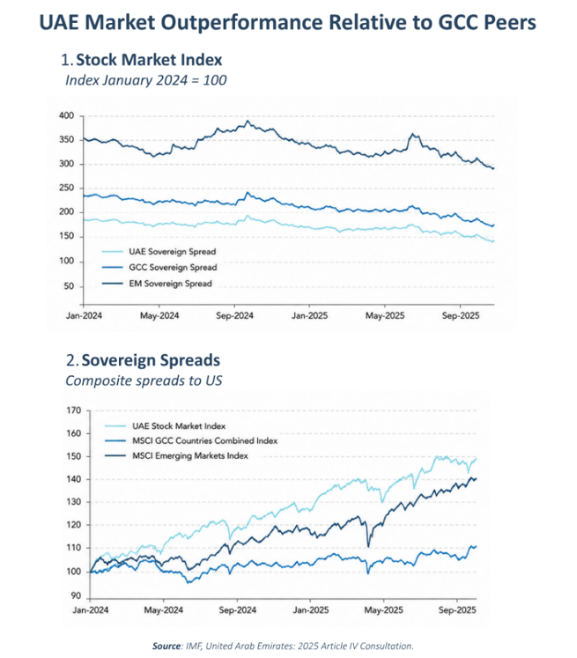
The IMF also emphasizes the UAE’s strong external and fiscal balances, demonstrating the country’s strong financial position and positive relationship with the global economy. UAE stock and bond markets have also outperformed Gulf Cooperation Council (GCC) countries and its own emerging market benchmarks, which shows that investors view the UAE as an attractive market.[6] The UAE outperforming its Gulf peers is a promising outlook for further foreign investment, and the country’s macro-level economic flexibility gives the country leeway to continue its current strategy.
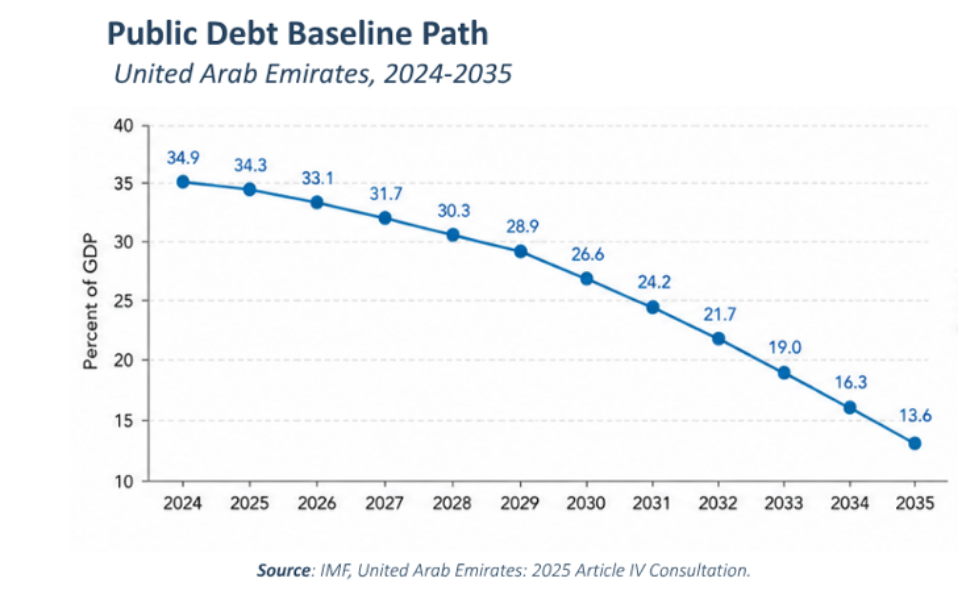
The UAE’s government finances in relation to its economy also appear stable. In 2024, the current account surplus rose to 14.5% of GDP, meaning the country earned more money from international transactions than it paid out. The fiscal surplus also strengthened to 6.4% of GDP in 2024, while government debt is expected to decrease to 33.1% of GDP in 2026. The IMF projects public debt to decline through 2035, mostly because of fiscal surpluses and the backing of SWF buffers. Despite its massive spending, the UAE’s ability to remove debt from an already low percentage of GDP signals that its system of economic governance works and will continue to do so through the future of its diversification, which includes AI.[7] These favorable debt dynamics indicate fiscal space, but do not by themselves establish that AI investments will earn adequate returns or produce a competitive domestic industry.
Although the IMF projects that oil prices are likely to fall below the level necessary for the UAE to break even fiscally, the country’s budget remains relatively stable. This suggests that the UAE may be better positioned to manage lower oil prices, although demonstrating reduced oil dependency would require additional evidence showing a sustained increase in the contribution of non-oil revenue to government finances. The IMF’s main concern regarding the future of the UAE’s AI ecosystem is that, after adjusting public finances to exclude hydrocarbons, the non-hydrocarbon deficit widened to 17.1% of non-hydrocarbon GDP, suggesting the non-oil side of the economy still relies heavily on fiscal support from SWFs and GREs. Furthermore, the UAE is subject to strong commodity price volatility from oil because of geopolitics and climate concerns.[8] Again, the biggest concern is the lack of self-sustainability that the UAE is building for its AI ecosystem. Can it survive without continued public financing, particularly when that support remains closely tied to oil revenues?[9] Based on these indicators, the UAE maintains fiscal reserves, giving the government greater capacity to sustain investment and absorb financial pressures.
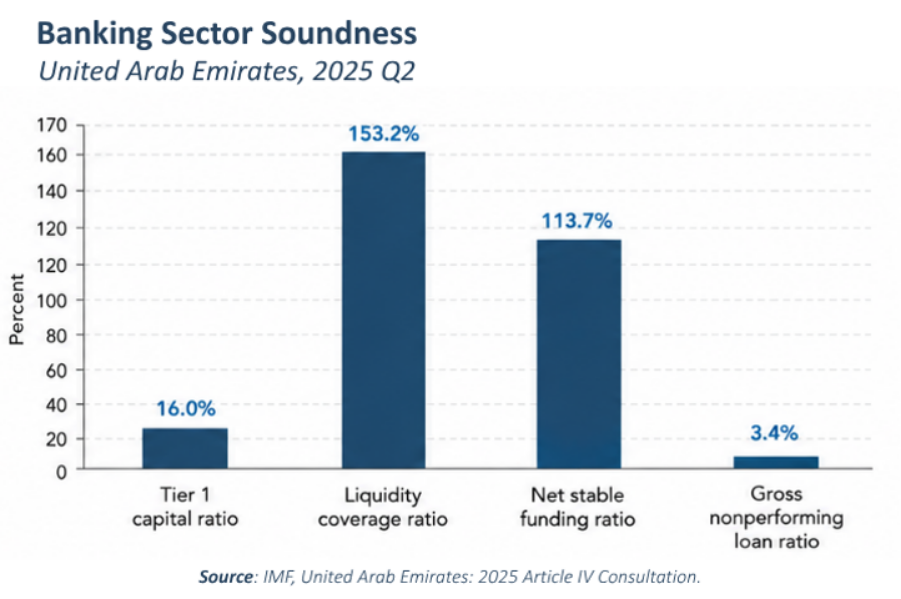
Despite concerns about self-sustainability and profitability, the UAE is prepared to invest significant capital upfront to make its AI ecosystem a global leader by 2031 and generate monetary returns over time.[10] According to the IMF, the UAE’s financial sector is well-capitalized. The banking system had a Tier 1 capital ratio of 16.0%, a liquidity coverage ratio of 153.2%, and a net stable funding ratio of 113.7%. These percentages suggest that banks have solid capital buffers, which include liquid assets to manage short-term pressures. The country also has stable sources of funding. Credit quality has also improved, with the gross nonperforming loan ratio declining to 3.4%. This indicates that fewer loans are becoming problematic, which strengthens the overall financial system. The UAE has already taken steps to mitigate major risks, including a potential real estate bubble, while maintaining a healthy lending market supported by demand from increasingly diversified sectors, particularly AI.
To summarize, the IMF report shows that the UAE has a straightforward financial foundation to support a major AI investment strategy. The country has strong public finances, large SWFs, investor confidence, a resilient banking system, and government assets through GREs. It is also important to note that the UAE AI strategy is both domestic and international, including a recent $1.4 trillion investment into the U.S.[11] This supports the idea that the UAE is not simply trying to develop AI at home but is also using foreign partnerships and overseas investment to secure access to technology, infrastructure, and strategic influence. Finally, the IMF report argues that the UAE should continue advancing non-oil diversification through investment in technology such as AI and other industries. The IMF specifically emphasizes that the UAE needs to be ready to deploy a large workforce for its new AI ecosystem.[12] While a massive AI workforce is a challenging task for many countries, for the UAE, importing skilled labor is common, as about 90% of its workforce is imported.[13]
The UAE aims to diversity its economy beyond oil. Investment in information and communications technology (ICT) can support this objective by enabling the development of technology-based industries and improving productivity across other sectors. The IMF estimates that the ICT investment multiplier is about 1.5 for overall GDP, compared with about 1.0 for non-ICT spending. The effect is even stronger for the non-oil economy, where ICT spending has a multiplier of about 1.8, compared with about 0.9 for non-ICT spending.[14] These statistics demonstrate more reason for the UAE to continue rapid expansion into AI. However, economy-wide ICT multipliers should not be interpreted as estimates of the returns to AI projects specifically; those returns depend on project selection, implementation, complementary skills, and demand.
Building a Sustainable AI Ecosystem
Given the government’s control over its domestic economy, the UAE can set ambitious goals for its AI ecosystem. Under its national agenda for entrepreneurship, the country aims to establish itself as a global leader in startups. This means that the UAE views startups as a key component in advancing AI domestically rather than building infrastructure for foreign companies. The UAE already performs strongly in international assessments: it ranks fifth in Stanford’s AI Vibrancy Index and thirteenth in Oxford Insights’ Government AI Readiness Index. [15] Together, these rankings indicate a relatively mature AI ecosystem and strong institutional readiness.
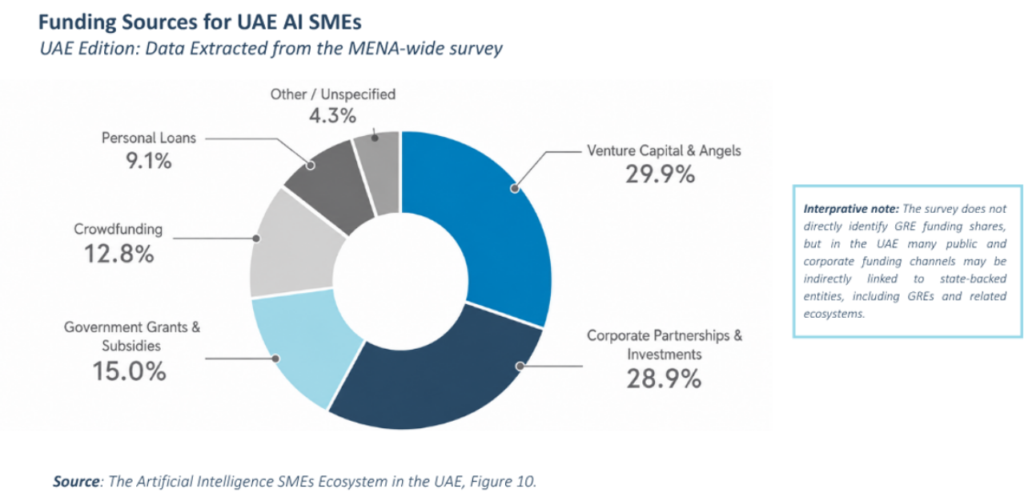
Venture capital and corporate partnerships or investments are the largest funding sources for AI-focused small and medium-sized enterprises (SMEs), each accounting for approximately 30% of funding. Government grants and subsidies provide roughly 15%, while self-financing, crowdfunding, and other sources collectively account for approximately 20%.[16] Although the funding does not clearly demonstrate the government spearheading development, capital funding will likely come from SWFs and GREs. Looking at the UAE’s strategy, the biggest concern is how it plans to utilize AI. It remains unclear whether the country will prioritize domestic startups and software development or focus primarily on building low-cost data centers to attract foreign companies. The UAE’s current trajectory therefore raises questions about domestic value capture and whether the country is creating a genuinely self-sustaining AI economy. A useful distinction is between access to advanced computing infrastructure, transfer of technical knowledge, and the emergence of domestic firms able to innovate and compete. The first two may facilitate the third but cannot substitute for evidence of domestic value creation.
Foreign Partnerships: Turning Global Technology into Domestic Capacity
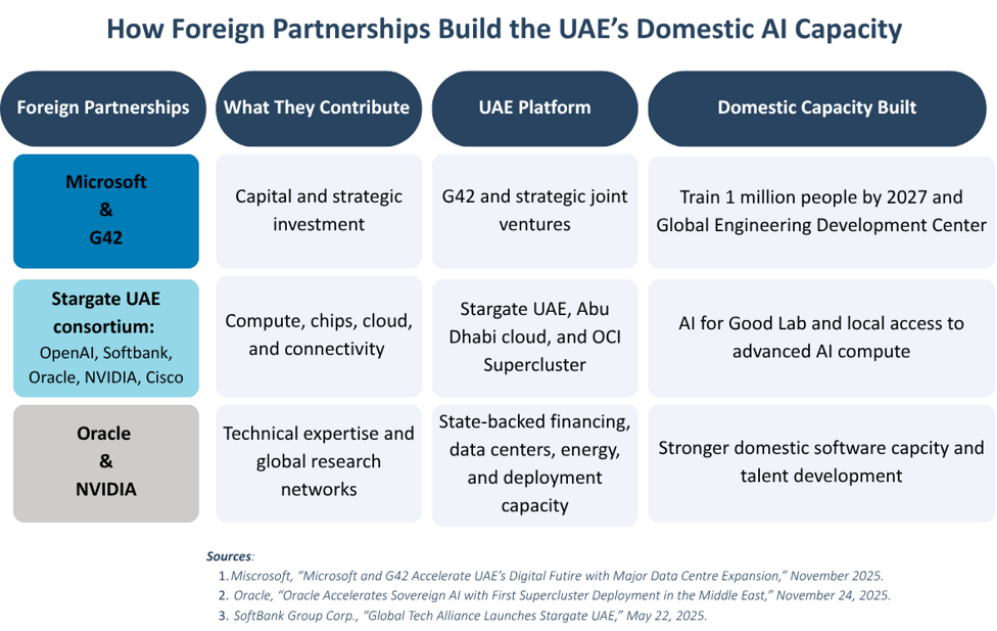
The simplest answer to concerns about value-capture is that the UAE does not intend to replicate the U.S. model. The UAE’s plan is not to build every part of the AI ecosystem through entrepreneurial innovation like the U.S. and other global superpowers. Instead, the country is using foreign partnerships to speed up its domestic AI software capacity, infrastructure, and workforce development. The strength of this strategy lies in its ability to combine state-backed domestic investment with the expertise and technology of major international firms. UAE-based G42 and Microsoft’s partnership following Microsoft’s $15.2 billion investment announcement in the UAE illustrates how the country is using global firms to accelerate domestic firms’ growth and expand data center capacity. Microsoft has committed to skilling one million people in the UAE by 2027, which directly supports the country’s goal of building a stronger domestic AI labor force. The partnership has also helped establish the Global Engineering Development Center and the AI for Good Lab in Abu Dhabi, creating opportunities for local talent and talent seekers abroad to gain experience in the UAE.[17] These initiatives demonstrate how the country’s investment strategy has begun to address concerns about domestic capacity and long-term value capture.
The Stargate UAE project further demonstrates the strength of the UAE’s foreign investment strategy. By bringing together G42, OpenAI, Oracle, NVIDIA, SoftBank, and Cisco, the UAE makes it clear to the rest of the world that they are open for business in the AI sector. Cisco providing zero-trust security and AI-ready connectivity, along with NVIDIA’ supplying Grace Blackwell GB300 systems, gives the UAE access to some of the world’s most advanced technologies.[18] Furthermore, Oracle expanding its Abu Dhabi cloud region through an OCI Supercluster powered by NVIDIA Blackwell GPUs gives governments and GREs across the Middle East access to advanced AI compute capabilities from within the UAE.[19] Stargate UAE addresses concerns about the country’s limited domestic software development capacity by using advanced chips and GPU’s provided by global tech companies, while it provides capital and infrastructure. The UAE is therefore not only importing technology but using U.S. and international innovation to build the foundation for a broader domestic AI ecosystem. Access to chips and cloud infrastructure expands computing capacity, but the extent of domestic technology transfer will depend on local participation in research, software development, training, and commercialization.
What the UAE Model Means for AI Competition and Economic Diversification
The UAE’s AI strategy shows how its financial strength and state-led investment model can accelerate AI development, but its long-term success will depend on whether those advantages translate into lasting domestic technological capacity. Its AI strategy demonstrates how its distinct state-led economic model can support rapid technological development without replicating the U.S. approach. The UAE has its own distinct system of governance and should instead be assessed by its ability to use its economic strengths to its advantage. Its powerful and steady financial system, along with strong global trade relationships, gives the UAE a unique opportunity to build its own AI ecosystem at a rapid speed. These advantages put the UAE in a position to become a dominant AI force in the Middle East and beyond.
The UAE has macroeconomic fundamentals to support its AI ambitions. Its public debt remains moderate. Strong fiscal and current account surpluses, in combination with substantial sovereign wealth fund buffers and state-led investment structure, allow the government to direct capital into strategic sectors such as technology quickly.[20]
Moreover, the UAE does not need to reproduce the U.S.’s AI ecosystem model because foreign partnerships have strengthened its investment strategy. Collaborations with Microsoft, NVIDIA, Oracle, OpenAI, and Cisco, gain the UAE access to advanced chips, cloud infrastructure, software expertise, and global AI networks. These partnerships address the UAE’s shortage of domestic AI talent workers. Furthermore, domestic firms such as G42 allow the UAE to anchor these partnerships inside its national economy.[21] Contrary to concerns over value-capture, the UAE is not simply importing AI technology, it is using foreign expertise to accelerate domestic capacity-building and expand its talent base. With its distinct government and economic structure, the UAE’s AI pursuit is better understood as a coordinated investment plan designed to turn state and foreign capital into technological capabilities, economic output and international influence that supports long-term economic diversification goals. More broadly, the UAE’s approach offers a test case for whether capital-rich, state-led economies can use international technology partnerships to accelerate AI development without replicating the entrepreneurial ecosystems of the United States or other global leaders. The strategy should therefore be judged not only by investment announcements and data-center capacity, but also by indicators such as domestic AI value added, private-sector participation, skilled employment, locally developed intellectual property, AI-enabled productivity gains, and commercially sustainable exports. These measures would help determine whether the UAE is converting financial capital into lasting economic capability.
References
Alkhoudi, Salma, Sarah Shaer, and Fadi Salem. The Artificial Intelligence SMEs Ecosystem in the UAE: Overcoming Challenges, Expanding Horizons. Dubai: Mohammed Bin Rashid School of Government, 2025.
AlRashdi, Mayed. UAE’s AI Infrastructure Build-out Supports Ambitions for Economy. Emirates NBD Research, June 11, 2025.
Badr, Karim, Koralai Kirabaeva, Charlotte Sandoz, and Amanda Sayegh. “Federalism and Fiscal Operations in the UAE.” International Monetary Fund, 2025.
Beschel, Robert P., Jr., Justin Dargin, Paul Dyer, and Andrew Letzkus. Gulf Industrial Policy in a Changing Global Economy. Middle East Council on Global Affairs, October 28, 2025. https://mecouncil.org/publication/gulf-industrial-policy-in-a-changing-global-economy/
Daboin, Jesus, Shreyas Gadgin Matha, Clement Brenot, and Ricardo Hausmann. Scientific and Technical Innovation in the UAE: A Capability-Based Approach. Growth Lab Working Paper no. 258. Growth Lab, Harvard Kennedy School, December 2023.
International Labour Organization. United Arab Emirates: The Employment, Environment, Climate Nexus Factsheet. August 2025.
International Monetary Fund. United Arab Emirates: Selected Issues. IMF Country Report no. 23/224. International Monetary Fund, June 2023.
International Monetary Fund. United Arab Emirates: 2025 Article IV Consultation—Press Release; Staff Report; and Statement by the Executive Director for the United Arab Emirates. IMF Country Report no. 25/327. International Monetary Fund, December 2025.
Korniyenko, Yevgeniya, and Weining Xin. Gulf Cooperation Council Diversification: The Role of Foreign Investments and Sovereign Wealth Funds. IMF Working Paper no. 25/174. International Monetary Fund, September 2025.
Microsoft. “Microsoft and G42 Accelerate UAE’s Digital Future with Major Data Centre Expansion.” Source EMEA, November 2025. https://news.microsoft.com/source/emea/2025/11/microsoft-and-g42-accelerate-uaes-digital-future-with-major-data-centre-expansion/
United Arab Emirates Government. “The National Agenda for Entrepreneurship and SMEs.” The Official Platform of the UAE Government. December 30, 2024. https://u.ae/en/about-the-uae/strategies-initiatives-and-awards/strategies-plans-and-visions/finance-and-economy/the-national-agenda-for-entrepreneurship-and-smes
Oracle. “Oracle Accelerates Sovereign AI with First Supercluster Deployment in the Middle East.” Oracle Middle East Regional, November 24, 2025. https://www.oracle.com/middleeast/news/announcement/oracle-accelerates-sovereign-ai-capabilities-with-the-launch-of-the-first-supercloud-cluster-2025-11-24/
Ray, Trisha, Ryan Pan, and Raul Brens. The New Playbook for AI Leadership: The Case of the United Arab Emirates. Atlantic Council GeoTech Center, 2026.
Richardson, Aris, Haley Yi, Michelle Nie, Simon Wisdom, Casey Price, Ruben Weijers, Steven Veld, and Mauricio Baker. “How Sovereign Is Sovereign Compute? A Review of 775 Non-U.S. Data Centers.” 2025.
Sergie, Mohammed. “UAE Touts $148B Investment in AI.” Semafor, November 7, 2025. https://www.semafor.com/article/11/07/2025/uae-says-its-invested-148b-in-ai-since-2024
SoftBank Group Corp. “Global Tech Alliance Launches Stargate UAE.” SoftBank Group Corp., May 22, 2025. https://group.softbank/en/news/press/20250522
U.S. Department of State. 2025 United Arab Emirates Investment Climate Statement. September 2025.
[1] Mohammed Sergie, “UAE Touts $148B Investment in AI,” Semafor, November 7, 2025, https://www.semafor.com/article/11/07/2025/uae-says-its-invested-148b-in-ai-since-2024.
[2] U.S. Department of State, 2025 United Arab Emirates Investment Climate Statement, September 2025.
[3] Karim Badr et al., “Federalism and Fiscal Operations in the UAE,” in United Arab Emirates: Selected Issues, IMF Country Report no. 25/328 (Washington, DC: International Monetary Fund, December 2025), 17–19, https://www.imf.org/-/media/files/publications/cr/2025/english/1areea2025002-source-pdf.pdf.
[4] Badr et al., “Federalism and Fiscal Operations in the UAE.”
[5] Badr et al., “Federalism and Fiscal Operations in the UAE.”
[6] International Monetary Fund, United Arab Emirates: 2025 Article IV Consultation—Press Release; Staff Report; and Statement by the Executive Director for the United Arab Emirates, IMF Country Report no. 25/327 (December 2025).
[7] International Monetary Fund, United Arab Emirates: 2025 Article IV Consultation.
[8] International Monetary Fund, United Arab Emirates: 2025 Article IV Consultation.
[9] Robert P. Beschel Jr., Justin Dargin, Paul Dyer, and Andrew Letzkus, Gulf Industrial Policy in a Changing Global Economy (Middle East Council on Global Affairs, October 28, 2025).
[10] Salma Alkhoudi, Sarah Shaer, and Fadi Salem, The Artificial Intelligence SMEs Ecosystem in the UAE: Overcoming Challenges, Expanding Horizons (Mohammed Bin Rashid School of Government, 2025).
[11]. The White House, “Fact Sheet: President Donald J. Trump Secures $200 Billion in New U.S.-UAE Deals and Accelerates Previously Committed $1.4 Trillion UAE Investment,” May 15, 2025, https://www.whitehouse.gov/fact-sheets/2025/05/fact-sheet-president-donald-j-trump-secures-200-billion-in-new-u-s-uae-deals-and-accelerates-previously-committed-1-4-trillion-uae-investment/.
[12] International Monetary Fund, United Arab Emirates: Selected Issues, IMF Country Report no. 23/224 (June 2023).
[13] International Labour Organization, United Arab Emirates: The Employment, Environment, Climate Nexus Factsheet (August 2025).
[14] International Monetary Fund, United Arab Emirates: Selected Issues.
[15] Alkhoudi, Shaer, and Salem, The Artificial Intelligence SMEs Ecosystem in the UAE.
[16] Alkhoudi, Shaer, and Salem, The Artificial Intelligence SMEs Ecosystem in the UAE.
[17] Microsoft, “Microsoft and G42 Accelerate UAE’s Digital Future with Major Data Centre Expansion,” Source EMEA, November 2025, https://news.microsoft.com/source/emea/2025/11/microsoft-and-g42-accelerate-uaes-digital-future-with-major-data-centre-expansion/.
[18] SoftBank Group Corp., “Global Tech Alliance Launches Stargate UAE,” SoftBank Group Corp., May 22, 2025, https://group.softbank/en/news/press/20250522.
[19] Oracle, “Oracle Accelerates Sovereign AI with First Supercluster Deployment in the Middle East,” Oracle Middle East Regional, November 24, 2025, https://www.oracle.com/middleeast/news/announcement/oracle-accelerates-sovereign-ai-capabilities-with-the-launch-of-the-first-supercloud-cluster-2025-11-24/.
[20] International Monetary Fund, United Arab Emirates: 2025 Article IV Consultation.
[21] Microsoft, “Microsoft and G42 Accelerate UAE’s Digital Future.”